| Status: | Active, full but can join waiting list |
| Contact: | |
| When: | On Thursday mornings 2nd |
| Venue: | Haslemere Town Hall |
LOCAL HISTORY GROUP
Leader Fay Foster
2nd Thursday monthly at 10.00 - 12.00 September to July at the Council Chamber, Haslemere Town Hall, High Street.
Attendance fee £10 per year.
Other information: half of the time is spent outside exploring local areas. Maximum distance 1/2 a mile and slow progress!
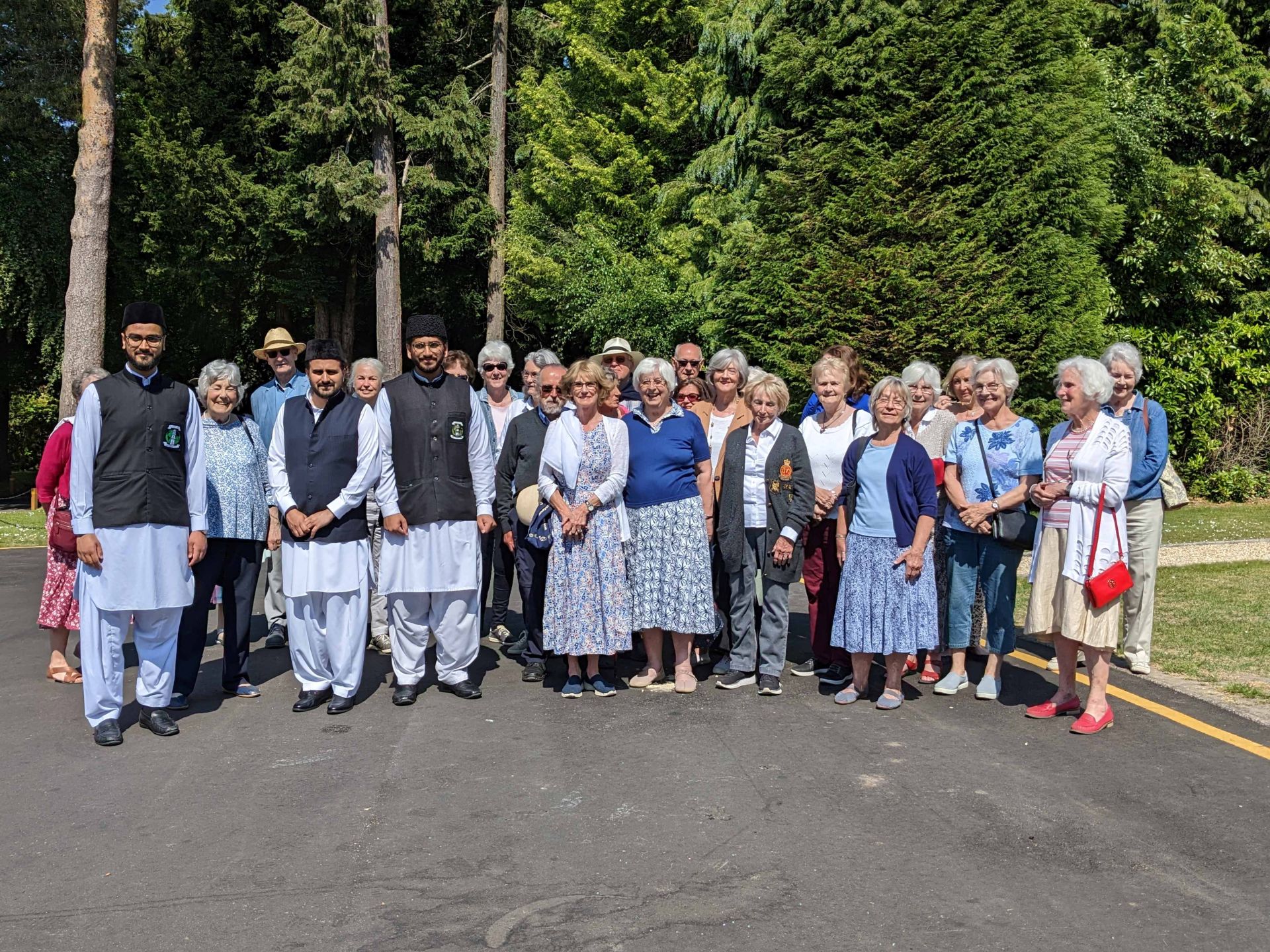
In October 2021 the group were given a private conducted tour of Shulbrede Priory in nearby Lynchmere by the current owners. Originally an Augustinian house founded in the late twelfth century, after the Dissolution of the Monasteries it was taken over by the Cowdray estate. Since the first Lord Ponsonby of Shulbrede bought it in 1902 it has been a home to his family ever since
This group is currently oversubscribed but the leader is happy to add your name to a waiting list if you are interested in joining in the future.
There is an article on the group’s activities since starting in 2019, and a particularly comprehensive and fascinating article about HMS Haslemere with much input from members.

Previous activities
The class started in September 2019 with 28 people signing on. These were a complete cross-section of ages and genders and even included a wonderful gentleman who was 100 years old in June 2020. In all, four classes were held in 2019 and three after Christmas up until the lockdown. One or two fell by the wayside but average attendance has been around twenty.
The main aim has been to walk around Haslemere, particularly the High Street, and note the buildings, their famous occupants or the institutions that have arisen in the town. See the list of activities already covered at the end.
Our visit to Haslemere’s Council Chamber initiated our most interesting research to date. Inspired by a drawing of a ship, HMS Haslemere, on the wall, a number of members decided to find out more and some fascinating history came to light.
HISTORY OF HMS HASLEMERE
During the First World War, the UK’s railways had been put under government control and with the return to peacetime more than one hundred railway companies were reorganised into four separate regional groups. With government retaining a controlling and regulatory role, Southern found themselves with more than the 2,100 miles of tracks, locomotives, and rolling stock. With the many stations came some substantial railway hotel assets, and also a dozen south coast ports and more than thirty ships. Just one year after formation Southern placed an order with the Glasgow shipbuilders for two new cargo steamers.
SS Haslemere was launched on the 22nd May 1925 and had cost Southern £42,250. The ship’s given name followed a tradition of using place names from Southern Rail’s rail region or ferry destinations, and so you find “sister” ships named for example, Maidstone, Fratton, Hythe and Deal.
HMS Haslemere was finally broken up in August 1959. Before that she served as a barrage balloon vessel and, as a Royal Navy ship, she was twice requisitioned by the Admiralty. At first she transported troops and supplies for the British Expeditionary Force to France and in June 1940 she took evacuees from Guernsey back to Weymouth.
In January 1941, while steaming up the Thames Estuary, crews of ships in the convoy saw a plane crash and its pilot parachute into to sea. Royal Navy escort ships including the Haslemere searched for survivors from the plane crash.
The crew on board the HMS Haslemere thought they heard a woman’s cries and attempted to rescue a person in the rough sea. A rope was thrown, but the person in the sea was too exhausted or too numb from the cold to take hold of it. Seaman Raymond Dean climbed down over the ship’s side at the stern and tried to grab hold of a motionless person in the sea. The person in the water was feet away when the stern of the Haslemere suddenly rose and fell violently in the stormy sea and the victim vanished. The lady turned out to be Amy Johnston, the famous aviator.
The captain of the Haslemere, Lieutenant Commander Walter E. Fletcher, dived into the freezing sea in an heroic but vain rescue attempt.
A boat was launched from HMS Haslemere but, in the poor weather conditions and strong tide, were unable to reach Lieutenant Commander Fletcher. He was posthumously awarded the Albert Medal in May 1941.On D-day 6 June 1944, HMS Haslemere escorted other boats to the Normandy Landing Beaches. On arrival at Gold Beach she acted as a Mulberry harbour. These were used as floating roadways that connected the pier heads to the beach).
(Coincidentally, the Mulberry harbour was invented by a Haslemere man, Robert Lochner, whose home, Rat’s Castle, Linchmere Road, Camelsdale, has a commemorative Blue Plaque).
Other connections with Haslemere
Earlier, in an effort to make a connection between his new ship’s mission and the country he served, Lt Cmdr Fletcher decided to contact the town of Haslemere.
After some enquiries he was given the name of Mr George Whitfield, a member of the then Haslemere Urban District Council – presumably Whitfield Road on the High Lane Estate was called after him. Just before Christmas 1940 a letter arrived with suggestions on how they might form a link and enclosing a card addressed to “the inhabitants of Haslemere” from “the inhabitants” of HMS Haslemere. Mr Whitfield in response sent about two dozen postcards of Haslemere for Lt. Comm. Fletcher to display in the officer’s mess and requesting information on the men of the ship’s company.
Further details of this new relationship are rather sketchy. What is known is that this topic was agreed for the agenda of the next British Legion meeting and the Haslemere Girl’s Club formed a knitting circle to create “comforts” for the crew. Sadly Lt. Commdr. Fletcher was killed not long afterwards. His initiative, however, survived him and in February 1943 there was an exchange of plaques between the Admiralty and Haslemere Town at the Haslemere Council offices to commemorate the adoption of HMS Haslemere
Further research after Amy Johnson’s death
There are many rumours about the actual death of Amy Johnson. She had taken off alone on 5th January 1941 in thick freezing fog from Blackpool airport. She was delivering a plane to Kidlington airbase in Oxfordshire – a simple 90-minute flight. Four and a half inexplicable hours later, Amy’s plane ditched in the Thames estuary – 100 miles off course.
Some say Amy was involved in the seedy unofficial business of flying a spy out of the country, perhaps a German lover. Some even reckon she was shot down by British anti-aircraft guns. Others have claimed that German planes could have taken her down. Still more said the crash was an elaborate plan to fake her own death. Nothing has ever been proved. But it is largely accepted that the crash itself occurred due to bad weather and risky judgement.
An actual witness came forward after sixty years. Derek Roberts, a clerk in the RAF flight office on the Thames, claimed “a parachutist had come down in the water”. His friend Cpl Bill Hall was on board HMS Haslemere. They spotted her parachute coming down and set out to rescue her. Amy actually called out to the crew that she was Amy Johnson, that the water was bitterly cold and could they get her out asap. They threw her a rope which she missed. Someone rushed to the bridge and reversed the ship’s engines as a result of which she was drawn into the propeller and chopped to pieces. Later in life Derek Roberts said he reckoned there had been an official cover-up over her death. The crew of HMS Haslemere claimed they saw two bodies floating in the Thames although she had set off alone. All very mysterious.
This has superseded the piece on the website as points 6 and 7 has been added.
OTHER TOPICS COVERED
1. A tour of the Haslemere Hall to learn its history and see facilities from the auditorium, backstage, under the stage and in the projection room
2. Notable residents Sir James Oglethorpe (founded State of Georgia), Rev James Fielding, (notorious highwayman), James Stewart Hodgson (philanthropist), Inspector Donaldson (murdered in the High Street), Sir Robert Hunter (founder of the National Trust), John Wornham Penfold (architect and benefactor), Helen Allingham (famous watercolorist), Sir Jonathan Hutchinson (surgeon and naturalist, founder of Haslemere Educational Museum).
3. Origin of the Town Hall and its Charter, and the history of local government in Haslemere.
4. Lecture by local historian, Jo Smith, on the Headley Riots of the late 1700s/early 1800s.
5. Information provided on local Morris dancing, ghost stories, well dressing, and many other topics introduced by members.
6. A guide took the group around St Bartholomew’s Church with its plaques to Tennyson and Gerard Manley Hopkins, and its heritage kneeler project.
7. A further guide gave a fascinating talk on St Christopher’s Church and it many Arts and Crafts features and artifacts.
8. A visit to Shulbrede Priory, the Grade I listed building near to Liphook founded in the late 12th century as a house for Augustinian Canons. The current owners, whose family who have lived there since 1902, gave a most interesting tour and history of the Piory.
CLASS LEADER: Fay Foster
Members of Haslemere U3A’s local history group visited Chiddingfold for their recent meeting in March 2022.
St Mary’s Church goes back to the 12th century and Haslemere was a mere chapelry in the parish. It wasn’t until 1869 that, thanks to the coming of the railway, Haslemere’s population grew and it became a parish in its own right.
The Crown Inn claims to have been established in 1285 when it was a Cistercian Abbey offering rest to pilgrims on the trail from Winchester to the shrine of St Thomas
Becket in Canterbury. Legend has it that there is a tunnel under the road directly into St Mary’s.
Over the past centuries the village has been an important centre for glass making, and the abundance of wood, water and ironstone led to many iron foundries. In fact glass was supplied to St George's, Windsor and St Stephen's, Westminster. It was understandable therefore that the church changed and extended to reflect needs of a growing and more prosperous congregation.
Looking around the church the group discovered many interesting artefacts. The stained glass is amazing ranging from the Glassmakers’ Window assembled in 1926 from fragments of Chiddingfold glass excavated in the village, to the modern Millennium window which is truly inspiring. The numerous plaques recall past citizens, notably the Winterton family of Shillinglee whose name also lives on in the inn of that name just outside the village, and Sir William Bragg, a Nobel prize winner for Physics.
In the midst of the tragedy of the Ukrainian War, it was surprising to learn of the important connection between Ukraine and Chiddingfold. ln 1949, many of the disabled Ukrainian workers in Britain sent here after World War ll, were threatened with repatriation to Russia. To prevent this happening Ukrainians in Britain contributed to the purchase and maintenance of a house where they could live without fear of deportation. With the money they raised, they bought Sydenhurst House on Mill Lane in Chiddingfold. For more than 60 years, Sydenhurst was their home and in that time many friendships were formed and continued until the house was sold in 2013.
As the residents of Syndenhurst grew older and died many of them were buried in St. Mary's Churchyard, where there is a special Ukrainian section. In the enormous churchyard, it was very moving to see the Cyrillic script on the marble tombstones. In fact just two weeks earlier Ukrainian Scouts from London came down to tend the graves and remember their forefathers.
An interesting morning and the Ukrainian link made it particularly special.
Fay Foster